

When dealing with a stubborn cut, burn, or ulcer, reaching for a jar of honey in the pantry might seem like a harmless natural remedy. Yet for open skin injuries, asking "is it safe to put manuka honey on wounds?" requires an important medical distinction.
The Short Answer: Yes, it is safe-only when using gamma-sterilized, medical-grade honey dressings. Applying unsterilized food-grade honey directly to open wounds risks introducing bacterial spores or impurities. Clinical honey dressings, by contrast, are sterilized after sealing in paper-aluminum composite pouches to guarantee single-use safety on compromised tissue.
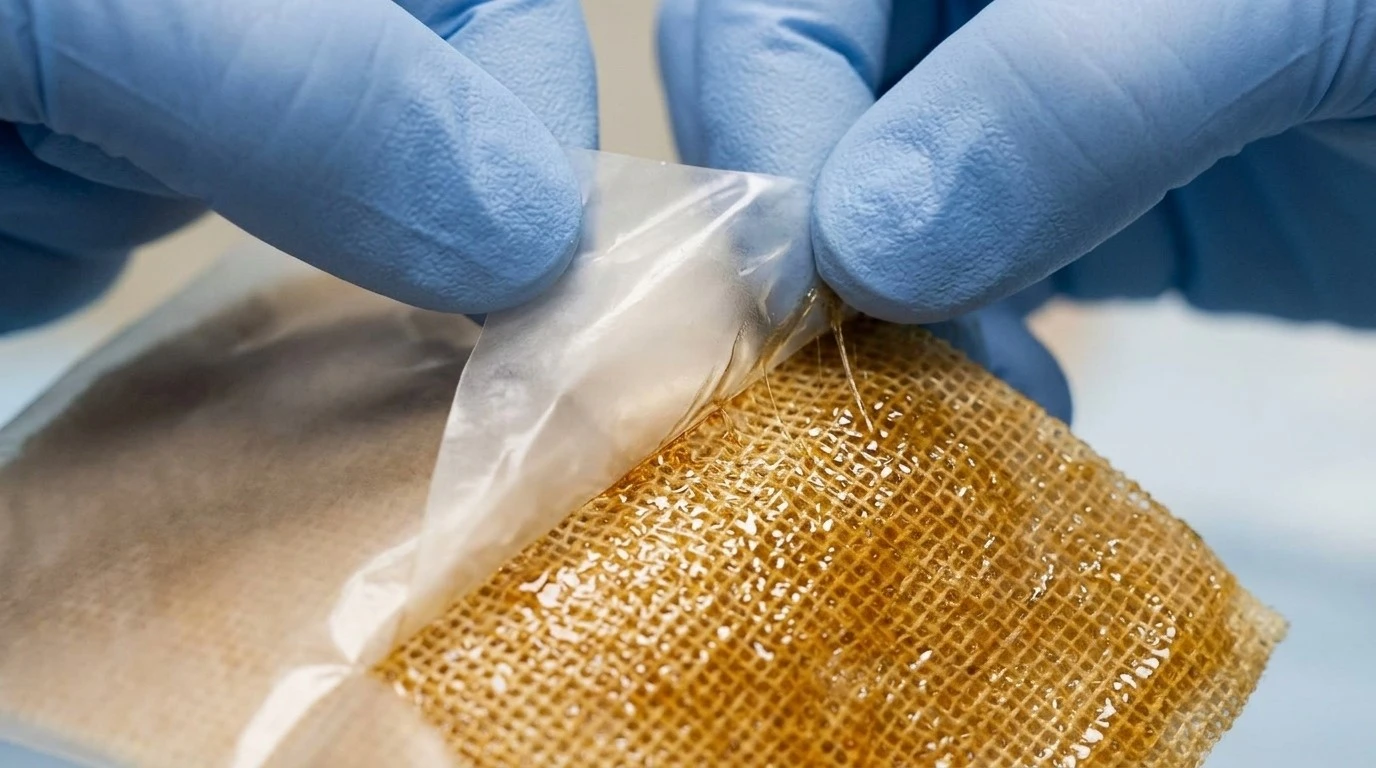
Household Honey vs. Sterile Medical Honey Gauze: What Makes the Difference?
To be safe for direct wound contact, manuka honey must be processed into a standardized medical device with verified purity and physical stability. Below is how a clinical-grade dressing differs from ordinary honey:
|
Safety & Quality Parameter |
Ordinary / Raw Honey |
Medical Honey Gauze Dressing (TDS Standard) |
|
Sterilization |
Unsterile; potential microbial or spore contamination |
Sterilized by irradiation after packaging and sealing for single use |
|
Purity & Impurities |
May contain pollen, wax, or environmental debris |
Free of visible foreign bodies and impurities; residue on ignition ≤ 2% |
|
Endotoxin & Heavy Metals |
Untested |
Bacterial endotoxin ≤ 4.0 EU/piece; heavy metal content ≤ 20 ppm |
|
pH Balance |
Variable |
Controlled within a wound-compatible pH range of 3.0–7.0 |
|
Structural Delivery |
Runny liquid that easily drips off skin |
Soft yellow/tan gauze (longitudinal strength ≥ 6.00 N, transverse ≥ 3.00 N) |
Because the honey is pre-infused into soft medical gauze, it maintains consistent contact across the wound bed without mess. For healthcare providers and home caregivers looking for a sterile, ready-to-apply option, choosing a certified honey gauze dressing. eliminates the contamination risks of raw honey while preserving a moist healing environment.
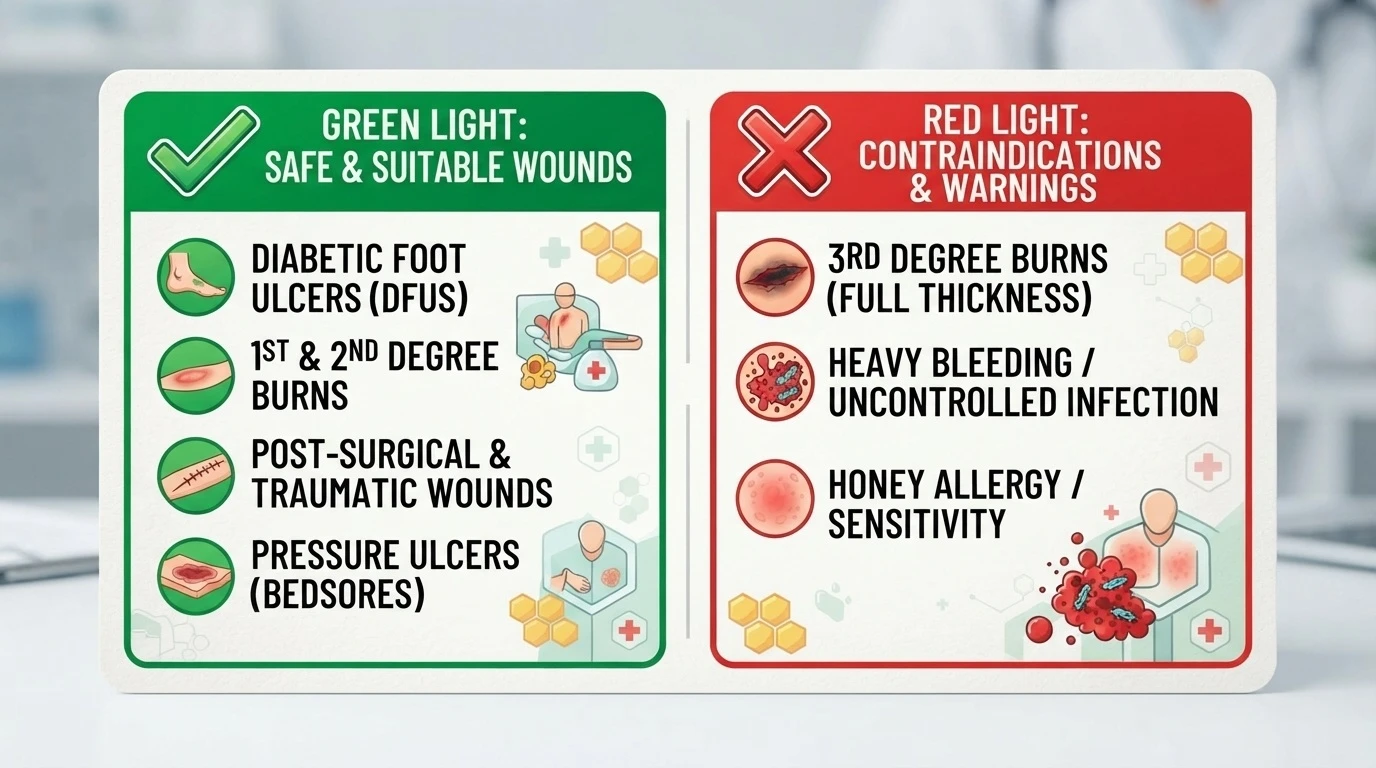
The Wound Safety Checklist: Green Light vs. Red Light
Even with sterile medical dressings, safety depends on matching the product to the right type of injury.
Green Light: Safe for Clinical Application
Medical honey gauze is specifically indicated for covering damaged surface wounds and supporting moist tissue recovery in:
• Chronic Non-Healing Ulcers: Diabetic foot ulcers, venous leg ulcers, and pressure ulcers.
• Post-Operative & Trauma Wounds: Unhealed surgical incisions and traumatic surface abrasions.
• Superficial to Partial-Thickness Burns: First-degree and second-degree burns and scalds.
Red Light: When to Avoid Use
Do not apply manuka honey dressings if any of the following conditions are present:
• Third-Degree Burns: Deep, full-thickness burns and severe scalds require specialized emergency intervention.
• Active Hemorrhage or Uncontrolled Infection: Contraindicated for heavily bleeding wounds or uncontrolled acute infections.
• Known Honey Allergies: Avoid completely in patients with known allergies or hypersensitivity to honey.
3 Golden Rules for Safe Application and Removal
Maximizing safety during dressing changes comes down to three clinical habits:
• Prep the Skin and Peel the Backing Cleanly: Cleanse the wound with sterile normal saline and gently dry the surrounding skin. Open the intact pouch, remove the protective film backing, and place the honey-coated side directly onto the wound bed before securing it with a secondary dressing.
• Respect Wear-Time Limits: Replace the dressing every 1 to 3 days-adjusting sooner if exudate is heavy or the gauze dries out. Never leave a single dressing on for more than 7 days, and keep cumulative treatment within 30 days.
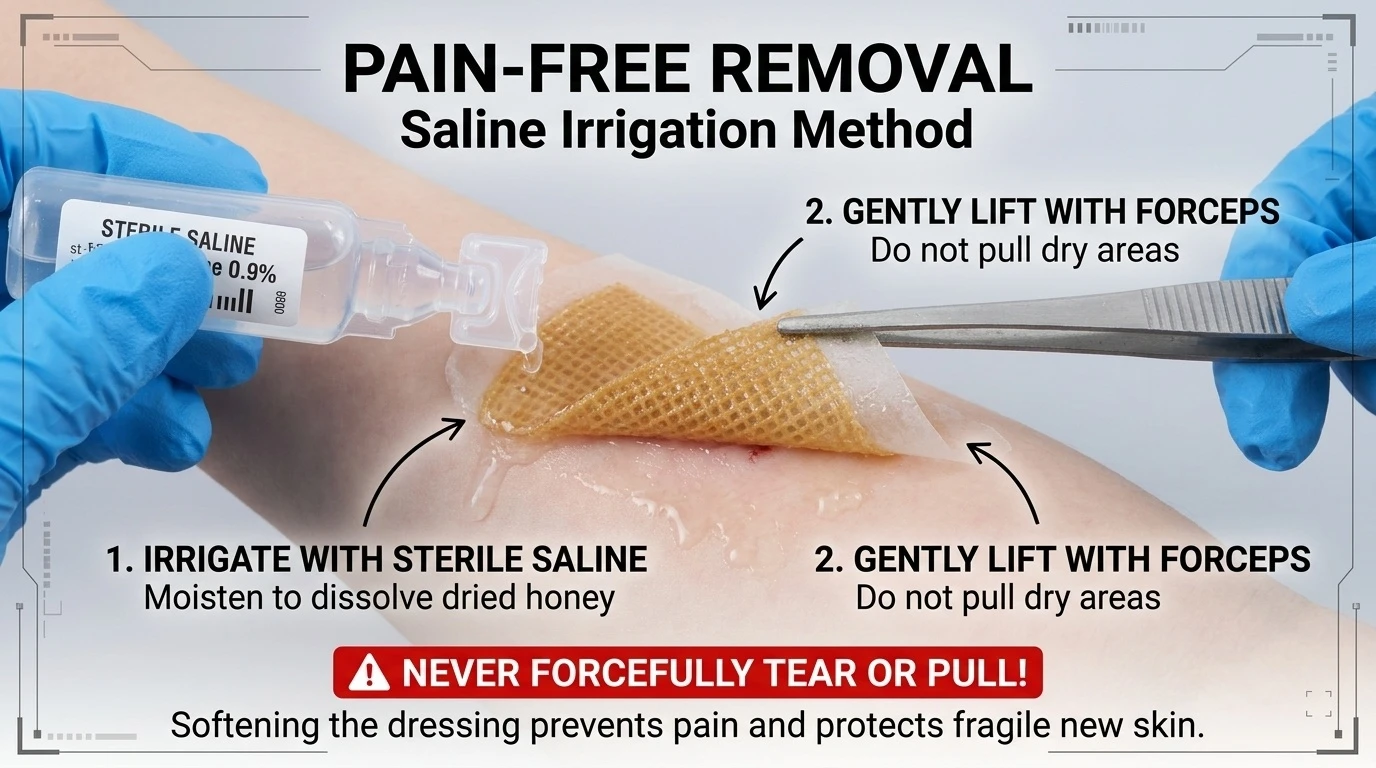
• Never Peel a Dry Dressing by Force: During removal with gloved hands or tweezers, if the dressing adheres to the wound surface, moisten it thoroughly with sterile normal saline first to prevent tearing fragile new tissue.
Practical Sizing & Storage for Safe Shelf Life
To prevent unnecessary cutting or overlapping on different wound shapes, sterile honey gauze dressings come in eight pre-cut dimensions-ranging from compact squares (5cm×5cm, 10cm×10cm, 11cm×11cm, 10cm×12.5cm, 10cm×20cm) to elongated strips (30cm×2cm, 30cm×2.5cm, 45cm×2cm). Keep unopened pouches in a cool, dry place away from light to preserve sterility across their 3-year shelf life.


